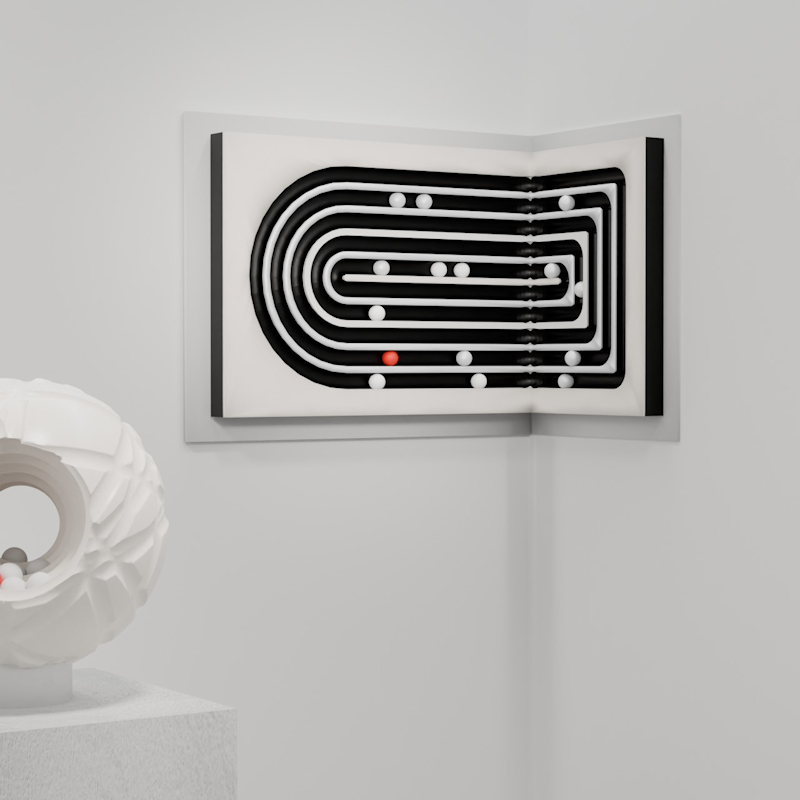
 Sculpture "Thinking the corner".
 Discover the sculpture here. Click image to enlarge.
Creative Thinking: Luxury or a hard business case?
At its core, transformational art transcends passive observation to become an active instrument for cognitive and cultural change. It serves as a physical trigger for creative thinking, challenging deeply held assumptions and rewiring how we engage with complexity. Rather than simply capturing a moment in time, it acts as a catalyst—bridging the abstract dynamics of human potential, leadership, and systemic evolution with tangible, spatial experiences. It is art that does not just ask you to look, but invites you to adapt, interact, and fundamentally shift your perspective.
My entire sculptural oeuvre is rooted in transformational art—works that shift perception and invite new ways of thinking. My sculptures are interactive or change with the viewer’s position, turning perspective itself into a catalyst for transformation. Across my body of work, the pieces create spaces for dialogue, shared reflection, and cooperative sensemaking. They encourage a move beyond competition toward collective intelligence, offering collectors and audiences not only an artwork but an environment that nurtures clarity, resilience, and the courage to accelerate change.
Taking “time to think” is often dismissed as a luxury. Yet creative thinking is a core leadership skill and a hard business case. As highlighted by IMD Business School, Lausanne, in an era where AI can process data instantly, a leader’s true competitive advantage is sensemaking—the human capacity to navigate complexity by discovering entirely new angles.
I unite a mature sculptural practice with extensive leadership experience and technology skills gained in a major financial institution, where I guided a large‑scale digital transformation focused on people and culture. As an experienced speaker, I have developed engaging talks and workshops on transformational themes, blending creative thinking with topics such as navigating crises, shaping winning teams, and fostering the mindsets required for continuous change.
Historically, the corporate landscape and the art world have existed in silos—often speaking different languages and struggling to understand the value of the other. The business world relies on measurable efficiency, while the art world thrives on ambiguity and exploration. My work—in sculpture, leadership, and dialogue—acts as a deliberate bridge between these two isolated realms. It demonstrates a simple truth: transformation begins the moment we choose to see differently, uniting the logic of business with the creative impulse of art to solve what comes next.